AI Experiment Challenges Long-Held Belief: “Salvator Mundi” Is Likely Not a Da Vinci
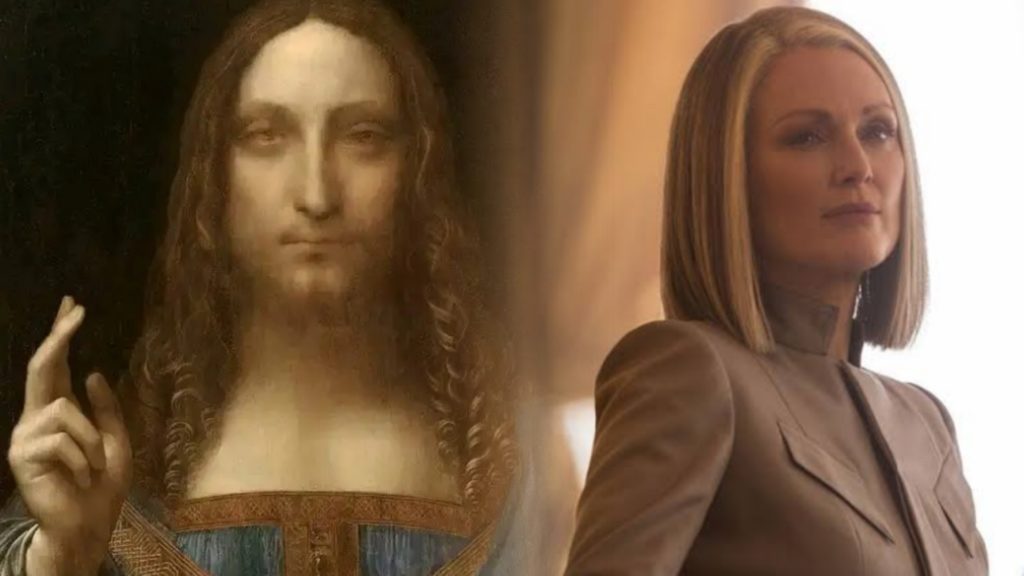
Sony Pictures has announced that a miniseries is already in production based on the 2021 documentary “The Lost Leonardo,” which explores the turbulent journey of the Salvator Mundi (left). The project will be led by actress Julianne Moore (right), who will portray the restorer Dianne Modestini. (IMAGES: Wikimedia Commons / Lionsgate)
In a development that may reshape one of the most heated debates in the global art market, Brazilian researcher and author Átila Soares da Costa Filho has presented new findings suggesting that the world’s most expensive painting, Salvator Mundi, is unlikely to be the work of Leonardo da Vinci. Instead, advanced AI analysis points to a strong probability that the painting was authored by Giovanni Boltraffio, a prominent Milanese disciple of the Renaissance master.
Soares, a specialist in Art History, Art & Technology and Artificial Intelligence, has long been at the forefront of digital methodologies for art authentication. Educated in Industrial Design at the Pontifical Catholic University of Rio de Janeiro, he has dedicated years to developing Luminari, an AI-driven system designed to analyze stylistic consistency across an artist’s body of work. The technology uses convolutional neural networks to assess whether an artwork aligns with the mathematical patterns derived from a given artist’s production.
Revisiting the Most Controversial Painting on Earth
Salvator Mundi—purchased for 450 million dollars by Saudi prince Mohammed bin Salman—has been surrounded by doubt since its rediscovery. Severely damaged and heavily restored, the painting has long sparked disputes among curators, historians and scientists. To eliminate the influence of later interventions, Soares employed a method that “reconstructed” the artwork digitally from its pre-restoration state. This version was then analyzed using Luminari’s updated dataset, now expanded with an intelligent balancing system and more than 10 billion internal parameters.
Complementary analysis by a German AI model, integrated into the experiment, found strong compatibility between the facial characteristics of the reconstructed painting and the version restored by conservator Dianne Modestini. Yet, once all tests were completed, Luminari delivered a striking conclusion: an 81% probability that the original painting was created by Giovanni Boltraffio. In the authentication field, a threshold of 75% is widely accepted as sufficient to attribute authorship.
Intriguingly, the model also detected signs of Da Vinci’s involvement, ranking him immediately after Boltraffio in likelihood. This suggests that the master may have supervised or contributed minimally to specific passages—a scenario consistent with Renaissance workshop practices.
A Tool, Not an Oracle
Despite the groundbreaking implications, Soares is cautious. He stresses that AI should not be treated as an absolute authority, but rather as one tool among many in a multidisciplinary process:
“Artificial Intelligence brings an impersonal and highly analytical perspective, but it is not an infallible judge. It expands the foundation of research, especially in areas where human perception cannot fully reach.”
Still, the ability of Luminari to work with artists who produced few surviving works—Leonardo has only 15 universally accepted paintings—marks a significant advance. In comparison, Picasso produced roughly 50,000 pieces, making traditional data-driven authentication far more feasible for modern artists. Luminari bridges this gap by generating consistent analytical baselines even from limited datasets, a feature protected under proprietary intellectual property.
A Researcher With Global Influence
Soares is recognized internationally for his work at the intersection of art and technology. He has previously reconstructed the face of the Virgin Mary using AI and identified references to the Shroud of Turin in several works attributed to Leonardo. He sits on scientific boards of institutions dedicated to Da Vinci’s legacy in Zurich, Milan, Rome and Varese, and contributes to the technical-historical journal Conservation Science in Cultural Heritage, tied to the University of Bologna and La Sapienza University of Rome.
His updated results were recently presented at a major conference in Italy, where leading Da Vinci scholars debated the evolving intersection between traditional connoisseurship and emerging digital tools.
A Turning Point in Art Authentication
If further confirmed, the conclusion that Salvator Mundi is more likely a work of Boltraffio—with possible input from Leonardo—could have enormous consequences for museums, collectors, insurers and the international art market. The case demonstrates a broader shift: as AI becomes increasingly sophisticated, the methods through which authenticity is established are entering a new era—one where science, technology and art history converge to revisit long-held assumptions about the world’s most treasured masterpieces.