European Space Mission Reveals Impact Damage on Asteroid Hit by NASA in Planetary Defense Test
Asteroid
The Hera spacecraft captures detailed images of the changes caused by NASA’s DART collision with Dimorphos. The impact created a stadium-sized crater, flattened part of the asteroid’s surface and altered its rotation.
A groundbreaking planetary defense experiment conducted by NASA is revealing important results. In 2022, the DART spacecraft deliberately collided with the asteroid Dimorphos at a speed of more than 21,000 kilometers per hour. The objective was to test whether a controlled impact could change the trajectory of a space object that might pose a threat to Earth.
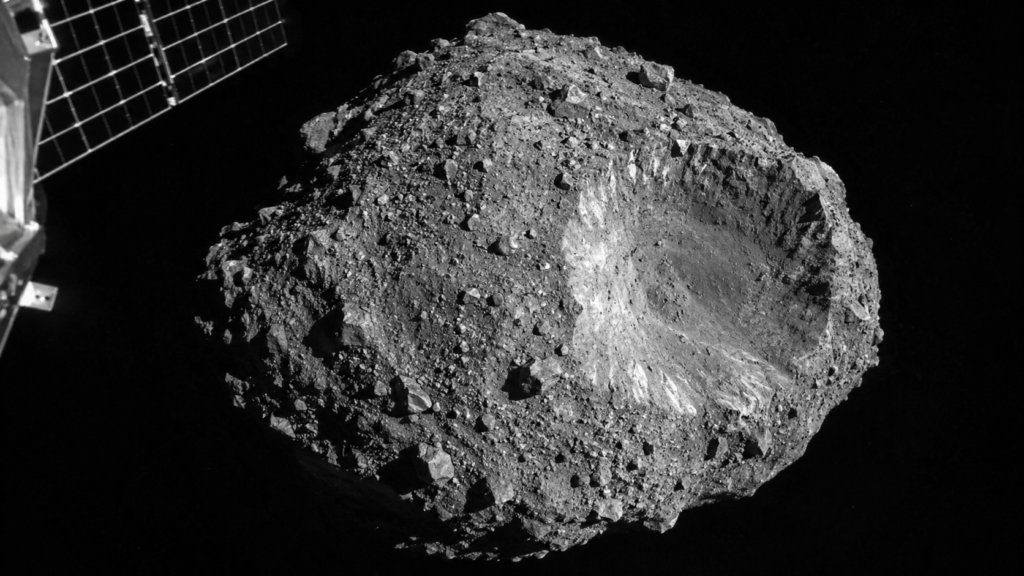
Four years later, the European Space Agency’s (ESA) Hera mission has captured detailed images showing the consequences of the collision. The images, released on Wednesday (November 25), reveal significant changes to the asteroid’s structure, particularly in the area struck by the spacecraft.
The observations show that the impacted section developed a flattened surface. The collision also created a crater comparable in size to a stadium, highlighting the enormous force of the impact.
Asteroid’s Rotation Has Become Chaotic
The Hera spacecraft also identified changes in Dimorphos’ movement. According to the mission’s observations, the asteroid is now rotating chaotically, indicating that the collision affected more than just its visible surface.
Another discovery involved several previously unidentified rocks now surrounding both Dimorphos and Didymos, a nearby asteroid.
Despite the changes observed around the impact site and the alterations in its rotation, the remaining structure of Dimorphos appears to have stayed largely unchanged.
Mission Could Improve Earth’s Planetary Defense Systems
The Hera mission plays a crucial role in understanding what happens when a spacecraft deliberately collides with an asteroid. While NASA’s DART mission demonstrated that an impact can change an asteroid’s orbit, Hera is investigating the physical consequences of that collision.
According to the European Space Agency, understanding these effects will help scientists develop more effective strategies for future planetary defense missions.
The goal is to improve techniques for redirecting space objects that could potentially threaten Earth.
International Cooperation to Protect the Planet
Hera mission manager Ian Carnelli highlighted the importance of combining the results obtained by the two missions.
“NASA’s DART mission demonstrated that we can alter an asteroid’s orbit. Now, Hera is revealing what happened to the asteroid itself. By combining these two missions, humanity is taking a decisive step toward making asteroid deflection a reliable tool for protecting our planet,” Carnelli said.
The experiment represents an important scientific advance in humanity’s ability to study and respond to potential threats from space.
With the data collected by Hera, scientists will be able to better understand how asteroids respond to impacts and which characteristics must be considered when planning future planetary defense operations.
The joint work between NASA and the European Space Agency expands scientific knowledge about these celestial bodies and strengthens the development of technologies that could prove essential to protecting Earth.