Trump Raises the Banner of Victory: “The End of an Era of Death and Terror” Marks a Defining Speech
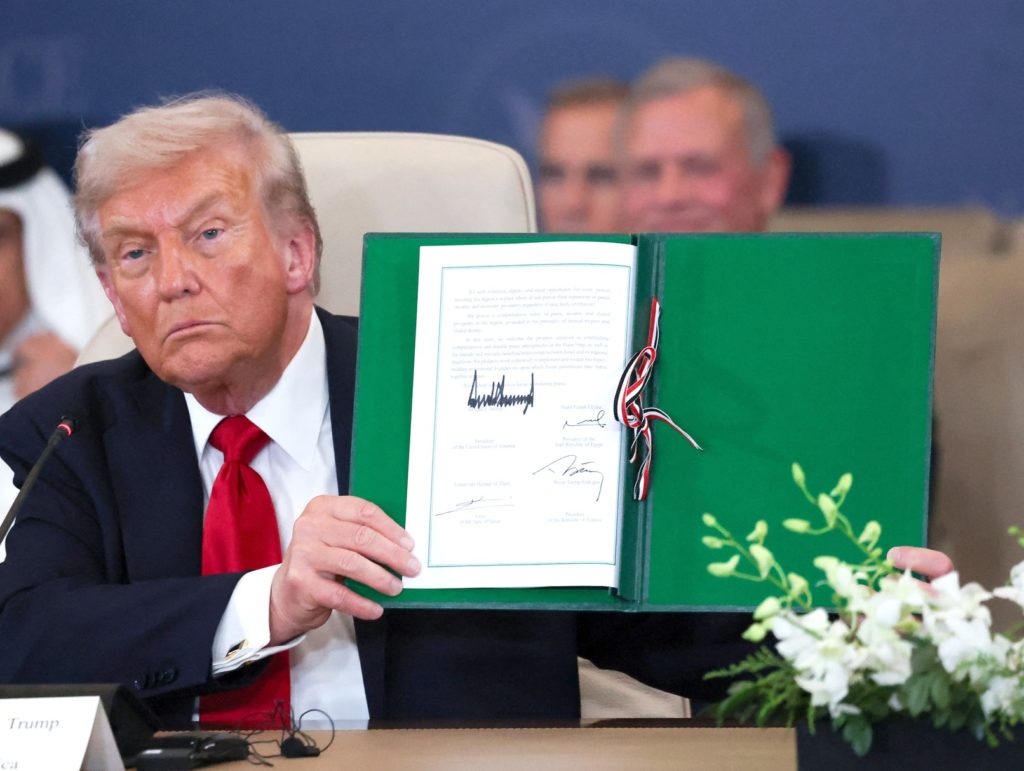
In a speech charged with symbolism and political weight, former U.S. President Donald Trump declared what he described as “the end of an era of death and terror,” following the release of hostages in the Middle East. Delivered before foreign dignitaries and international media, his words sought to portray a decisive turning point and reestablish his image as a global statesman capable of reshaping history.
The address, meticulously staged as both political theater and diplomatic statement, framed the release of the hostages not merely as a humanitarian victory but as a spiritual and strategic rebirth. Trump spoke with conviction, emphasizing that the moment represented not just the close of a violent chapter, but the dawn of “a new era of faith, justice, and reconciliation.”
At the core of his rhetoric lies the figure of Trump as a providential mediator — the man who transforms discord into diplomacy and chaos into order. By celebrating the release, he positioned himself not only as a beneficiary of peace efforts but as their principal architect, reflecting a renewed bid for geopolitical relevance and American leadership on the world stage.
Yet beneath the grand tone of triumph lies a far more complex reality. The release, while symbolically powerful, does not guarantee lasting stability. Sustainable peace requires engagement with multiple stakeholders — from Israeli and Palestinian authorities to regional partners and global institutions. The absence of concrete details in Trump’s remarks — such as security guarantees, monitoring mechanisms, or timelines for reconstruction — leaves open questions about how the proclaimed “new era” will be sustained beyond rhetoric.
Trump promised reconstruction and regional cooperation, vowing that the liberated territories would be “rebuilt through justice and dialogue.” However, he avoided specifics on the political, military, and financial costs such reconstruction would entail. His speech also skirted discussions about the role of international organizations and the extent of U.S. involvement in the next stages of peacekeeping and rebuilding.
Much of the speech’s power derived from its polarizing tone. Trump’s narrative clearly defined adversaries and allies, echoing his familiar style of moral and political confrontation. While his supporters see the event as proof of bold leadership, critics interpret it as another carefully choreographed display of populist symbolism — a message tailored as much for domestic politics as for global diplomacy.
Whether this marks a genuine step toward peace or another moment of political theater, Trump’s words once again placed him at the center of an international stage eager for certainty, but still navigating the fragile balance between hope and history.