Space Enters a New Military Era as U.S. Confirms Weapons in Orbit
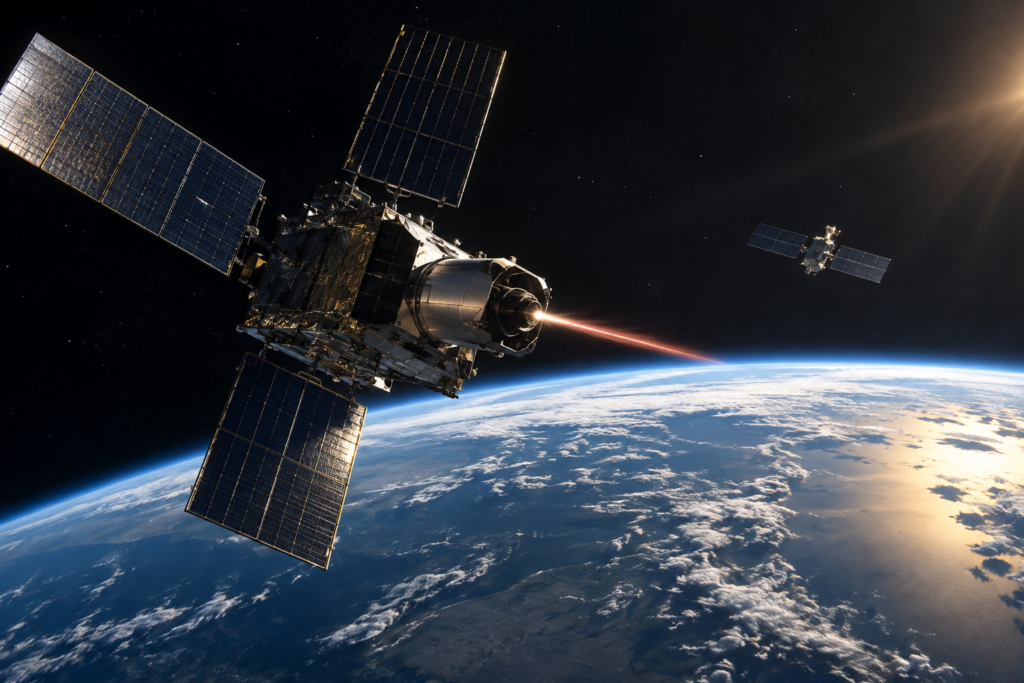
The competition for military superiority has moved decisively beyond Earth’s atmosphere. The United States has confirmed that it possesses space-control weapons deployed in orbit, capable of protecting American forces and strategic assets against potential hostile actions. The disclosure marks a new chapter in the growing militarization of space and highlights the strategic competition involving Washington, Beijing and Moscow.
The confirmation came from U.S. Air Force Secretary Troy Meink during a conference in Maryland. While acknowledging the existence of these military capabilities, the American official did not provide detailed technical information about the systems, how they operate or when they were deployed.
The development comes at a time when space is no longer viewed primarily as a domain for scientific exploration, telecommunications and Earth observation. Satellites have become essential to modern military operations, supporting navigation, communications, intelligence gathering, surveillance and missile detection. Disabling or destroying such systems could significantly reduce a country’s ability to respond during an armed conflict.
The United States, China and Russia have increasingly invested in space technologies with military applications. Washington has expressed concern over Chinese and Russian capabilities designed to interfere with, disable or potentially destroy satellites. These technologies have made orbital infrastructure an increasingly important component of national defense strategies.
The possibility of conflict in space also raises concerns because modern societies have become heavily dependent on satellites. Weather forecasting, banking systems, cargo transportation, GPS navigation, emergency services and digital communications all rely, directly or indirectly, on infrastructure operating above the planet. A large-scale confrontation involving satellites could therefore have consequences extending far beyond the military sphere.
The militarization of space also presents complex legal questions. The 1967 Outer Space Treaty establishes restrictions on placing nuclear weapons and other weapons of mass destruction in orbit. However, the agreement does not impose a comprehensive prohibition on conventional weapons in space, leaving significant room for legal and diplomatic debate as new technologies continue to emerge.
At the same time, the United States is developing a new generation of missile-defense capabilities. Among the initiatives is the proposed “Golden Dome,” envisioned as a system designed to strengthen the country’s ability to detect and intercept threats targeting American territory. Space-based technologies could become an important component of such a defensive architecture.
These developments are transforming Earth’s orbit into an increasingly important arena for international security. During the Cold War, the space race was largely associated with scientific achievements, technological prestige and milestones such as landing astronauts on the Moon. Today, the competition has acquired a much more explicit military dimension.
The American confirmation illustrates how the strategic balance among major powers is expanding into a new domain. Future geopolitical competition may no longer be limited to land, sea, air and cyberspace. Increasingly, it could also unfold hundreds or even thousands of kilometers above Earth’s surface, where satellites and other orbital systems have become critical assets for both national security and everyday life.