
Between Symbolism and Politics: How a Speech Turned a Detail into a Global Message
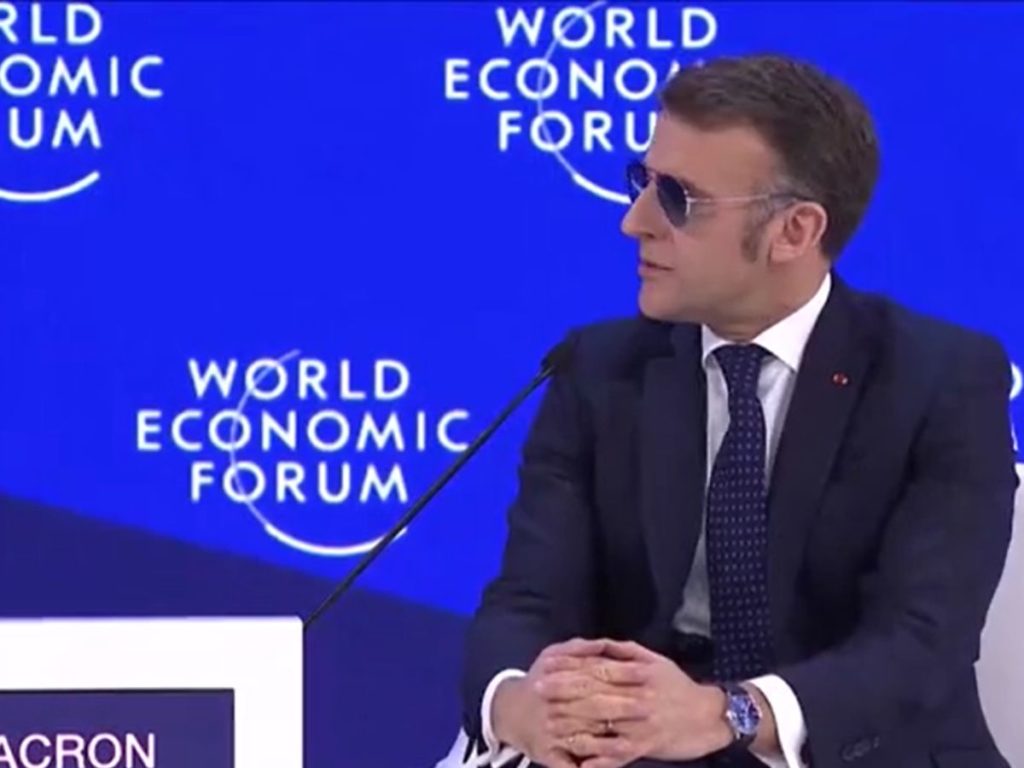
A seemingly simple detail was enough to trigger commentary, analysis and interpretation on the international stage: French President Emmanuel Macron delivered a speech wearing dark sunglasses during a major global forum held in Davos. Unusual in an environment defined by diplomatic formality, the gesture briefly shifted attention away from the substance of the address and toward the image of the French leader, reigniting debates about political communication, symbolism and public perception.
At high-level international gatherings, every visual element is typically calculated with precision. Posture, attire and body language are scrutinized as closely as the words spoken from the podium. Within this context, the use of sunglasses during an official speech broke with expected protocol and immediately sparked speculation about its meaning. Curiosity went beyond aesthetics, raising questions about why the president chose to keep the accessory on throughout his remarks.
The explanation, however, was far removed from any carefully planned symbolic strategy. Macron was experiencing eye discomfort caused by a temporary condition that made direct exposure to intense lighting particularly uncomfortable. In an environment known for strong stage lights, common at large international events, the choice was to protect his vision and maintain focus, even while aware that the decision would attract attention. What was essentially a practical measure quickly acquired an unexpected political dimension.
The episode highlights how, in the era of instant communication, global leaders are subject to constant interpretation, often disconnected from the actual content of their messages. Within minutes, images circulated widely, fueling analyses about supposed hidden signals, assertions of power or deliberate attempts to stand out. What began as a functional choice became an international talking point.
Despite the visual repercussion, the speech itself followed the French president’s familiar line: a defense of multilateralism, an emphasis on international cooperation and warnings about economic and geopolitical challenges that demand collective responses. Even so, for part of the audience, the accessory proved more memorable than the ideas presented, underscoring the weight of image in contemporary politics.
Political communication experts often note that, at global events, form can directly compete with substance. A single detail that deviates from the norm can be enough to redirect the focus of debate and shape public narratives. In Macron’s case, the sunglasses acted as an unintentional symbolic trigger, revealing how modern leadership operates under constant scrutiny, with every gesture amplified.
The episode also illustrates a recurring tension between humanity and protocol. By prioritizing comfort and health, the president appeared more vulnerable and human, even if that choice clashed with formal expectations. For some observers, this human dimension brings leaders closer to the public; for others, it disrupts the ritual traditionally associated with a head of state on the global stage.
Ultimately, Macron’s speech in Davos will be remembered not only for the proposals it contained, but for the implicit lesson it offered about political communication in the twenty-first century. In a hyperconnected world, where images travel faster than arguments, even a pair of sunglasses can become a message. And often, the detail speaks just as loudly as the speech itself.