PIETRO COSTA IN THE BRAZILIAN DELEGATION: XV INTERNATIONAL POETRY FESTIVAL IN BUCHAREST
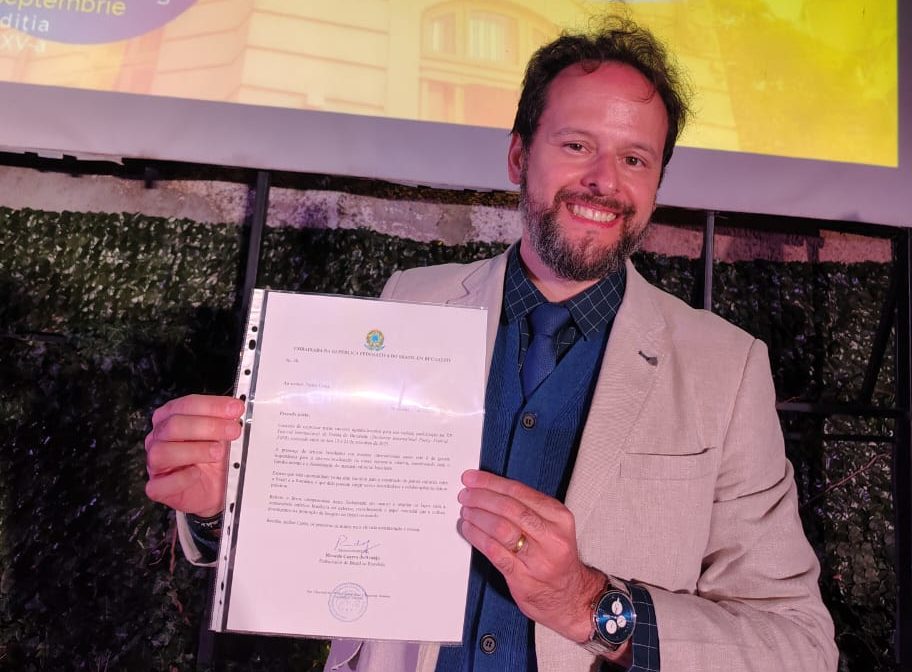
PIETRO COSTA
The International Poetry Festival of Bucharest (FIPB), founded in 2012, is organized by the National Museum of Romanian Literature (MNLR) and brings together significant voices from the global poetic scene.
In its 15th edition (September 15–21, 2025), the FIPB became a true planetary celebration of the word. For an entire week, poets from all continents gathered in recitals, round tables, workshops, cultural visits, and open dialogues with the public.
Bucharest in 2025 was a living agora of world poetry.
Indeed, literature, with its universality, flows naturally in the propagation of thoughts and emotions, expressing human complexity in every language.
In the graceful garden of the Museum of Literature in Bucharest, fertile seeds of poetry blossomed, coming from Romania, Sweden, China, Colombia, Uruguay, Portugal, Italy, Honduras, Spain, Mexico, Switzerland, Germany, Greece… and from Brazil!
It was an immense honor for the writer, poet, and cultural activist from Brasília, Pietro Costa, to represent Brazilian poetic strength on the evening of September 18, 2025, alongside the luminous poets Bernadete Saidelles (Rio Grande do Sul) and Eva Potiguara (Rio Grande do Norte), and Izabelle Valladares, president of Literarte (Rio de Janeiro).
To be in Romania, the land of the immortal Mihai Eminescu, representing Brasília and Brazil, was a privilege Pietro Costa carries as both a literary and human journey.
During those days, poetry was not just a word—it became a bridge between cultures, a bird in flight across continents.
From the very first moments, the Brazilians were warmly welcomed with affection, sympathy, and respect, especially by the remarkable writer Dino Flamand, translator into Romanian of Fernando Pessoa, Clarice Lispector, and Carlos Drummond de Andrade, among others; by cultural attaché Ronaldo Vieira; by Professor PhD Alina Bianca Andreica (Associate Professor in Computer Science; Faculty of European Studies; Manager of UBB Brazilian Centre “Casa do Brasil” at Babes-Bolyai University, Cluj-Napoca, Romania); and by Professor Gabriela Toma, PhD, Director of the National Museum of Romanian Literature.
At the Festival, the Brazilian delegation was not merely a spectator: it was a protagonist of a vibrant exchange, bringing its works to the world’s poetic agora in September, in the Romanian capital, which hosted representatives from around thirty countries.
The brilliant Brazilian delegation captivated all eyes and attention: Izabelle Valladares with her fervent and emotional oratory; Pietro Costa, Bernadete Saidelles, and Eva Potiguara with the strength of their poetic voices, origins, and legacies.
Just as Romanian violins modulate melodies of pain and joy, Brazilian literature resonates with its distinctive rhythms—at times soft as bossa nova or chorinho, at times fiery as samba de raiz or the ancestral beat flowing from our Afro-Indigenous roots.
This multifaceted identity reflects contemporary Brazilian literature, forged from all corners of the land, marked by sunshine and storms, by dreams that endure, and by sorrows that dance.
Brazilian spirit set the tone in Bucharest with its lyrical, critical, inventive, popular, and vibrant power, unveiling horizons of fraternity, beauty, hope, and resilience. Through intercultural dialogue, it reaffirmed its universality.
The living pulse of Brazilian literary creation, when heard on Romanian soil, resonated with the same cadence in which Eminescu dreamed of poetry’s immortality and Brâncuși shaped in matter the search for infinity.
The world must listen—with the same reverence reserved for Neruda or Lorca—to names such as Cecília Meireles, with her intimate and visceral poetics; Drummond, with his diamond-pen turning stones into poetic jewels; Conceição Evaristo, with her ancestral lyrical cry breaking silences; Manuel Bandeira, with his unrestrained verses; Manoel de Barros, with his lyrical art of “collecting” wastelands; Hilda Hilst, who dared to fuse the erotic and the metaphysical; and Augusto dos Anjos, whose poetic intensity still moves us with its modernity, among many others.
The writer from Brasília had the honor of donating copies of Requintes de Sensibilidade, Eclipser, and SolRidente to cultural attaché Ronaldo Vieira and Professor PhD Alina Bianca Andreica.
These simple yet symbolic gestures reaffirmed the mission of the Brazilian delegation: to sow integration, strengthen ties, and build bridges.
It is also worth remembering the magical night of September 18, in the gardens of the Museum of Literature, when Pietro Costa gifted a copy of SolRidente to Romanian artist Vlad Galatianu, who, to everyone’s surprise, closed the evening with a bossa nova performance. It was as if Brazil and Romania joined hands through music.
Another moving moment came on September 19, when the Brazilian delegation visited Liceul Teoretic Eugen Lovinescu, the largest Portuguese-language teaching center affiliated with Instituto Camões in Romania.
It was deeply rewarding to meet vibrant and curious students, unafraid to recite, ask questions, and dream. Books were donated, conversations flowed, and impressions were shared.
The Brazilian delegation walked through the corridors adorned with plaques from Expo Romania 2025, where Pietro Costa’s works Indizível, Gritantes Feições, Voz Incorruptível, Olhares Fugidios, and Amor Genuíno were displayed.
Yes—poetry is indeed the universal language of fraternity and peace, capable of reaching even the most hostile hearts.
But poetic art was not limited to stages and auditoriums. Bucharest also offered the Brazilians its monumental architecture—the Parliament, the historical heritage of a vibrant city—and the beauty of landmarks such as Peleș Castle in Sinaia and the Black Church in Brașov.
Unforgettable gatherings also marked the journey, such as the dinner at The Mark restaurant, where the Brazilian delegation planned strategies, laughed, shared confidences, and strengthened bonds of friendship.
There were also more relaxed moments in the city center, exploring Bucharest’s nightlife and Romanian cuisine—because culture is also experienced at the table.
In every corner of Bucharest, in every exchanged glance, in every heartfelt applause, it became clear: poetry is not only literature—it is diplomacy, affection, history, and resistance.
Pietro Costa expresses deep gratitude to God, his family, supportive friends, Literarte, the Brazilian Embassy, Itamaraty, the National Museum of Romanian Literature, Gabriela Toma, the Literary Arcadias, cultural organizations of which he is a member, and all who made this encounter possible.
He returns to Brazil certain that poetry can indeed transform the world—verse by verse, encounter by encounter.
And he leaves an invitation: let us continue together, because his long literary journey, from coast to coast, is only beginning.
May new and contemporary poets, alive today, break borders and be justly recognized overseas for their vast creative expression.